> ## Documentation Index
> Fetch the complete documentation index at: https://docs.summand.com/llms.txt
> Use this file to discover all available pages before exploring further.
# Use cases
> Talk to your Summand data in natural language from any MCP-aware AI client.
Once the Summand MCP server is connected, you can talk to your data the same way you talk to any AI assistant. There's no query language, no API to learn, and no dashboard to navigate — just ask. The client picks the right tool, calls it on your behalf, and folds the results back into the conversation.
This works in any OAuth-aware MCP client, for example [claude.ai](/api-reference/mcp/connect#add-to-claude-ai) or [ChatGPT](/api-reference/mcp/connect#add-to-chatgpt),
## Example conversation
A typical first session walks from "what do I have?" to "what does it tell me?" in three turns.
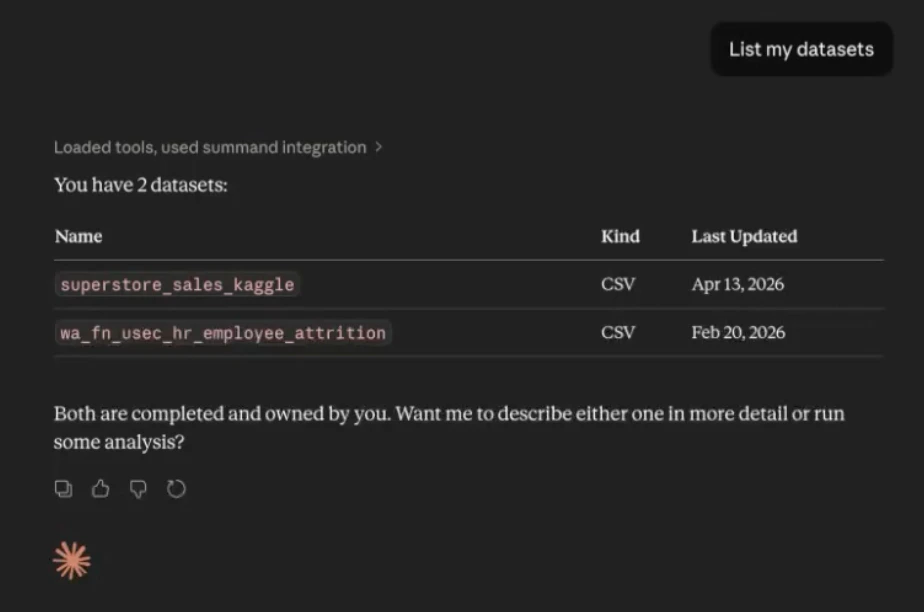
### 1. List your datasets
Start by asking what's available. The client calls `list_datasets` (and/or `list_data_connectors`) and shows you everything you own or have been shared.
> "List my datasets."
 ### 2. Dig into one of them
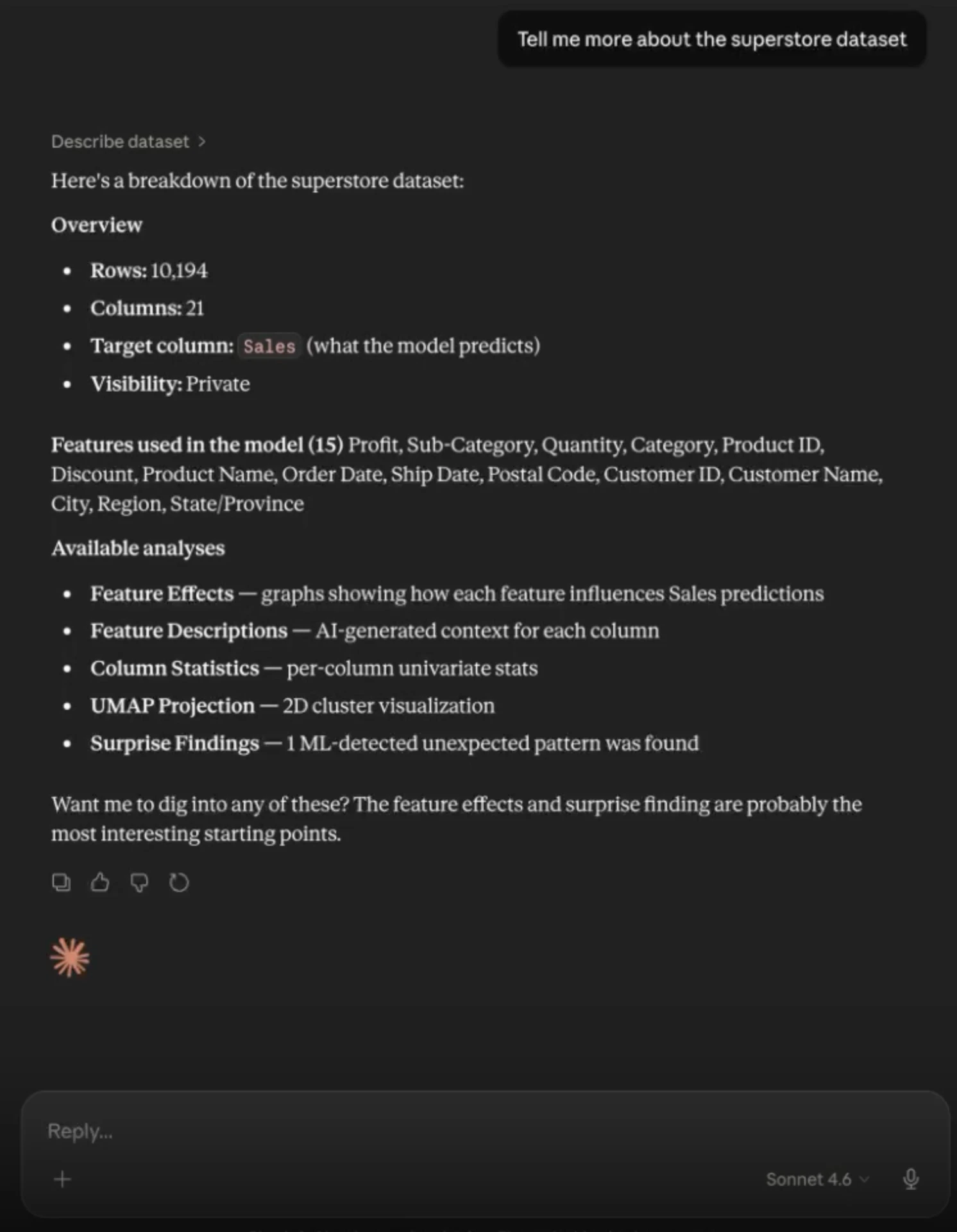
Pick something interesting and ask for more. The client pulls metadata, columns, and the available semantic-layer components in a single turn.
> "Tell me more about my superstore sales dataset."
### 2. Dig into one of them
Pick something interesting and ask for more. The client pulls metadata, columns, and the available semantic-layer components in a single turn.
> "Tell me more about my superstore sales dataset."
 ### 3. Pull a specific analysis component
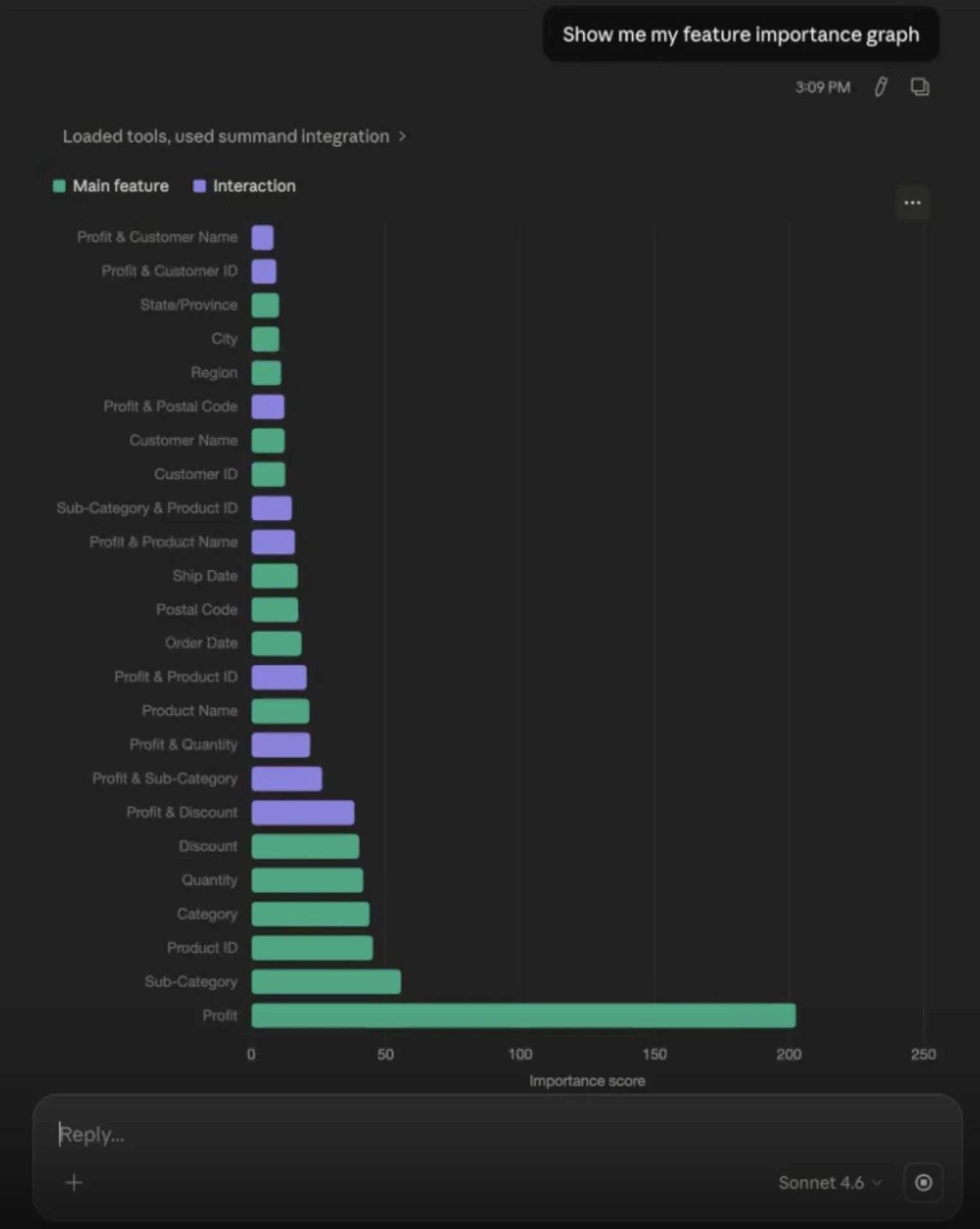
Once you know what's available, ask for the analysis you actually want — feature importance, surprise findings, column distributions, embeddings, anything in the semantic layer.
> "Show me the feature importance graph for that dataset."
### 3. Pull a specific analysis component
Once you know what's available, ask for the analysis you actually want — feature importance, surprise findings, column distributions, embeddings, anything in the semantic layer.
> "Show me the feature importance graph for that dataset."
 ## Other things to try
* **Compare two datasets.** *"What columns are in my Q3 sales data but not in Q2?"*
* **Surface surprises.** *"What surprising findings did Summand pick up in the attrition dataset?"*
* **Investigate a single feature.** *"How does `JobLevel` affect attrition? Show me the EBM contribution."*
* **Audit your sources.** *"Which data connectors do I have, and what kind of database is each one?"*
The MCP server is read-only, so anything you ask is bounded by what you can already see in the Summand dashboard — owned resources plus anything explicitly shared with you.
## Other things to try
* **Compare two datasets.** *"What columns are in my Q3 sales data but not in Q2?"*
* **Surface surprises.** *"What surprising findings did Summand pick up in the attrition dataset?"*
* **Investigate a single feature.** *"How does `JobLevel` affect attrition? Show me the EBM contribution."*
* **Audit your sources.** *"Which data connectors do I have, and what kind of database is each one?"*
The MCP server is read-only, so anything you ask is bounded by what you can already see in the Summand dashboard — owned resources plus anything explicitly shared with you.